ENERGY APPLICATION
Ultrasonic Spray Coating of Perovskite Thin Films: the Scale-Up Path from Spin Coating
A 2026 Science Advances paper reports spin-cast layered hybrid perovskite films with record-low thermal conductivity (~0.04 W/m·K) and the stiffness of an engineering plastic. Spin coating doesn't scale; ultrasonic spray deposition does. This page and its white paper lay out the process engineering: ink compatibility, gas quenching, roll-to-roll layout, and swirl-gas quench control.
Why ultrasonic spray fits perovskite inks
Hybrid perovskite precursor inks are true solutions, ammonium halide and PbI₂ in DMF/DMSO at roughly 1–10 cP, with no particles to clog a nozzle. That is comfortable territory for ultrasonic atomization, and the peer-reviewed record agrees: ultrasonically spray-coated perovskite absorbers were demonstrated in 2014 and fully spray-coated devices have followed. A 120 kHz nozzle's fine droplet population suits thin, smooth layers; 60 kHz covers thicker builds.
One balance, three levers
Film quality is set by one balance: droplets must arrive wet enough to merge, but dry enough not to flood, and a gas quench then decides when, and how sharply, drying finishes.
Three levers act on that balance almost independently: the nozzle and its gas environment set how wet the film starts; bottom-side substrate heating sets the baseline drying rate; and the gas quench triggers the fast, film-wide crossing into supersaturation that nucleates compact, well-oriented crystals. With ultrasonic spray, in-flight evaporation already delivers a partial quench: droplets can arrive near supersaturation before the film even forms.
Gas quenching and the ultrasonic droplet field
Perovskite film quality depends on crossing into supersaturation quickly and uniformly: slow solvent loss nucleates few crystals that grow coarse and disconnected; a sudden, film-wide crossing nucleates densely and yields compact, well-oriented films. Spin-coating labs trigger this with an antisolvent drip; scalable processing replaces it with a gas quench, a dry nitrogen or air knife that strips the solvent-vapor boundary layer from the wet film so the evaporation rate jumps everywhere at once.
Three couplings arise when the wet film is produced ultrasonically. The spray is already a partial quench: in-flight evaporation concentrates each droplet, so with stand-off, gas flow and substrate temperature tuned, droplets arrive already near supersaturation, and the film-level quench has less work to finish than after blade or slot-die coating. The quench overrides droplet-scale drying: a sprayed film is thousands of merged droplets, each edge prone to its own coffee-ring flow, and the knife's job is to impose one fast film-level drying event before individual droplet edges pin, a window of seconds after droplet merge. And the knife must not touch the plume: ultrasonic plumes are low-momentum by design, so deposition gas-shaping and the quench knife are separate flows with separate jobs, spaced apart in position or time.
Starting points: dry N₂, a few m/s at the film, 20–40 mm working distance, 1–5 s after deposition. DMSO is hygroscopic, so quench-gas humidity is a first-order reproducibility variable.
Roll-to-roll layout and swirl-gas quench control
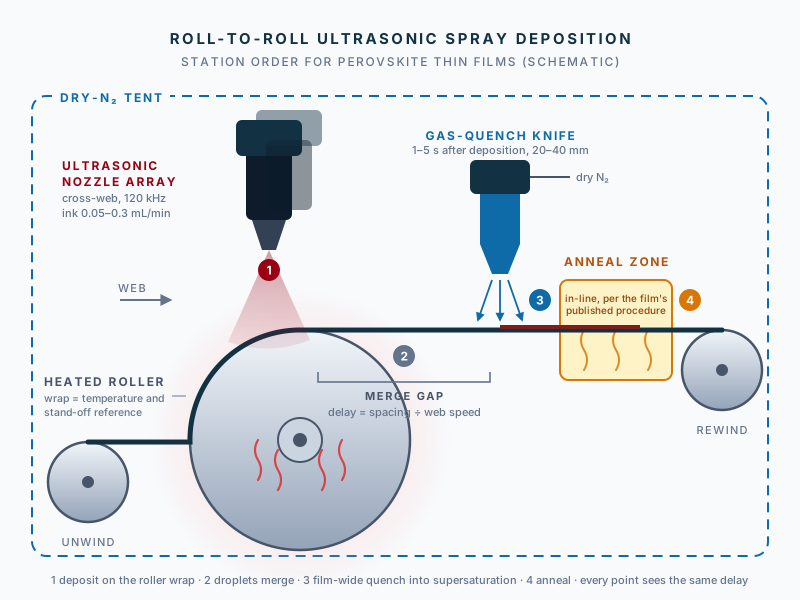
On a moving web, fixed stations turn quench timing into geometry: every point sees the same deposition-to-quench delay. The working order is a cross-web nozzle array over a heated roller wrap (the wrap doubles as a mechanical reference that stabilizes stand-off), a short merge gap, a cross-web dry-N₂ quench knife, and an in-line anneal zone, all tented under dry nitrogen.
A swirl-gas nozzle adds a control no other coating method offers: dry N₂ through the swirl adjusts in-flight evaporation, moving droplet arrival state along the wet-to-supersaturated axis independently of stand-off and substrate temperature. On a web, swirl confinement lays self-patterned stripes in the parallel-cell geometry perovskite modules already use, without masking. The quench knife acts downstream of the low-momentum spray plume: two gas flows, two separate jobs.
Conservative starting window (bench, 120 kHz)
- Ink: precursor solution in DMF/DMSO, 1–10 cP, 0.2 µm-filtered
- Flow rate: 0.05–0.3 mL/min
- Stand-off: 30–60 mm
- Substrate temperature: 70–110 °C (web-material limited)
- Quench: dry N₂ knife, a few m/s at the film, 20–40 mm, 1–5 s after deposition
The 2026 thermal-insulation films were produced by spin coating; spray deposition of that specific material is a proposed scale-up, and matching the spin-cast film's orientation and conductivity is the central development task. Cited studies were performed by independent groups on their own equipment.
Technical white paper
Ultrasonic Spray Deposition as a Scale-Up Path for Layered Hybrid Perovskite Thermal-Insulation Films. Free download, fully referenced (September 2026):
- Ink compatibility and the wetness/evaporation balance
- Gas quenching: mechanism and its three couplings with an ultrasonic droplet field
- Roll-to-roll station layout with heated-roller design math
- Swirl-gas in-flight quench control and stripe self-patterning
- Starting process window, safety handling, full references
Related pages
- Vortex Nozzle, the swirl-gas nozzle for in-flight quench control
- Solar Cell Coating, perovskite and thin-film photovoltaic layers
- Gas Diffusion Electrodes for CO₂ Electrolysis, another application note with a white paper
Why ultrasonic spray for perovskite films
- ✓True-solution inks, no clogging. Precursor solutions at 1–10 cP in DMF/DMSO carry no particles and sit well inside ultrasonic atomization's working range.
- ✓Frequency picks the layer. A 120 kHz nozzle's fine droplet population suits thin, smooth layers; 60 kHz covers thicker builds and higher flows.
- ✓In-flight evaporation is a partial quench. Droplets can arrive near supersaturation before the film forms, so the film-level gas quench has less work to finish.
- ✓A low-momentum plume a quench knife can follow. Deposition gas-shaping and the quench are separate flows with separate jobs.
- ✓Swirl-gas control and self-patterned stripes. Dry N₂ through a swirl nozzle tunes droplet arrival state, and swirl confinement lays parallel stripes on a web without masking.
- ✓Standalone components. 60 and 120 kHz nozzles, broadband generator and liquid delivery integrate with your own motion system, web line or glovebox.
Selected literature
Cited as published. The 2026 thermal-insulation films were spin-cast; the spray-deposition studies concern perovskite solar-cell absorbers and nanoparticle layers, and none of the work was performed on MicroSpray equipment.
- Extremely Low Thermal Conductivity in Rigid Layered Hybrid Perovskites
Z. Wang et al.
Science Advances 12, eaee5269 ·
Open access · no paywall
The spin-cast films this page proposes to scale: ~0.04 W/m·K with a 7.7 GPa elastic modulus.
- Layer formation and morphology of ultrasonic spray coated polystyrene nanoparticle layers
J. Stryckers et al.
Physica Status Solidi A 213, 1441–1446 ·
The wetness-versus-evaporation balance that governs ultrasonically sprayed layers.
- Efficient planar heterojunction mixed-halide perovskite solar cells deposited via spray-deposition
A. T. Barrows et al.
Energy & Environmental Science 7, 2944–2950 ·
The 2014 demonstration of ultrasonically spray-coated perovskite absorbers.
Recommended Equipment
Vortex Nozzle
Swirl-gas co-flow: dry N₂ through the swirl adjusts in-flight evaporation and, on a web, confines the plume into self-patterned stripes
View details →Zero Air Nozzle
Pure ultrasonic atomization at 120 kHz for the finest droplet population and thin, smooth layers; 60 kHz for thicker builds
View details →Liquid Delivery (Syringe Pump)
Pulsation-free feed across the 0.05–0.3 mL/min bench window, with delivered-volume records for coverage calculations
View details →Common Questions from Research Groups
Can hybrid perovskite precursor inks be sprayed with an ultrasonic nozzle?
Yes. Perovskite precursor inks are true solutions in DMF/DMSO at roughly 1–10 cP, well within ultrasonic atomization's working range, with no particles to clog a nozzle. Ultrasonically spray-coated perovskite films have been reported in the peer-reviewed literature since 2014.
What does a gas quench do in spray-coated perovskite films?
A dry nitrogen knife strips the solvent-vapor boundary layer from the freshly deposited wet film so the whole film crosses into supersaturation at once, nucleating densely and producing compact, well-oriented crystals instead of coarse, disconnected ones. With ultrasonic spray, in-flight droplet evaporation already provides a partial quench before the film forms.
Does perovskite spray deposition work roll-to-roll?
Yes. Fixed stations along a moving web (nozzle array, merge gap, gas-quench knife, anneal zone) give every point on the web an identical deposition-to-quench delay set by station spacing and web speed. Depositing on a heated roller's wrap stabilizes both temperature and nozzle stand-off.
Scaling a spin-cast film?
MicroSpray nozzles are standalone components: 60 and 120 kHz nozzles, broadband generator, and liquid delivery that integrate with your own motion system, web line, or glovebox. Tell us your ink, substrate and target thickness and we'll recommend a frequency and starting window.