
ENERGY APPLICATION
Spray Pyrolysis
High-temperature nanoparticle formation and crystalline thin-film deposition for transparent conductive oxides (TCOs), metal oxide sensors, and energy storage materials using ultrasonic spray pyrolysis.
The Challenge
Spray pyrolysis requires precise control of substrate temperature, spray rate, precursor chemistry, and nozzle-to-substrate distance. Substrate temperatures below 200 °C produce powdery deposits from incomplete solvent evaporation, while temperatures above 350 °C cause re-evaporation and porous films. Conventional spray techniques produce inconsistent droplet sizes that make it difficult to achieve uniform crystalline thin films of metal oxides like ITO, AZO, and FTO.
Our Solution
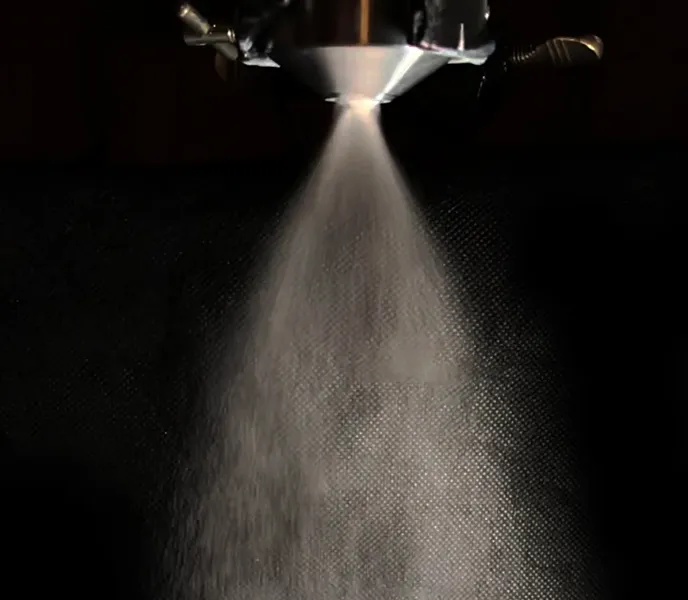
MicroSpray ultrasonic nozzles bring precision and process stability to spray pyrolysis by atomizing precursor solutions into uniform microdroplets. The consistent droplet size leads to reproducible film thickness and properties, while the self-cleaning design minimizes clogging during continuous high-temperature operation. Compared to conventional spray or CVD techniques, ultrasonic spray pyrolysis offers greater control, higher efficiency, and lower material waste with no vacuum requirement.
Why Ultrasonic Spray?
- ✓Fine, consistent droplets ensure uniform thin-film deposition on complex geometries
- ✓High transfer efficiency reduces waste of expensive precursor materials, more economical than CVD
- ✓Self-cleaning nozzle design minimizes clogging during continuous operation
- ✓Reproducible film thickness and properties for large-scale production
- ✓ITO, AZO, and FTO transparent conductive oxide deposition for solar cells, touchscreens, and OLED displays
- ✓Nanostructured metal oxide films (Fe₂O₃, NiO, TiO₂) for gas sensors, photocatalysts, and environmental monitoring
- ✓Energy storage material deposition including NiO, SnO₂, and LiCoO₂ for batteries, supercapacitors, and solid-state devices
- ✓Lower spray rates produce superior crystalline films with controlled morphology and resistivity
Supporting Research
Peer-reviewed publications and technical literature relevant to this application area. Links open the publisher's site.
- A self-driving laboratory optimizes a scalable process for making functional coatings
C. C. Rupnow, B. P. MacLeod, et al. — Berlinguette Group, University of British Columbia
Cell Reports Physical Science ·
Open access · no paywall
Spray deposition in this work was performed using a MicroSpray ultrasonic spray system.
- The Leidenfrost effect during spray pyrolysis of nickel oxide–gadolinia doped ceria composite thin films
U. P. Muecke, G. L. Messing, L. J. Gauckler
Thin Solid Films ·
- Silver Nanoparticles from Ultrasonic Spray Pyrolysis of Aqueous Silver Nitrate
K. C. Pingali, D. A. Rockstraw, S. Deng — New Mexico State University
Aerosol Science and Technology ·
Open access · no paywall
Recommended Equipment
ThermalSpray™ High-Temperature Ultrasonic Nozzle
Primary nozzle for spray pyrolysis at substrate temperatures of 200–850 °C
View details →Vortex Nozzle
Wide spray pattern for uniform precursor delivery across large substrates
View details →Liquid Delivery (Dosing Pump)
Pulse-free precursor feed at low flow rates for reproducible film thickness
View details →Common Questions from Research Groups
Can the nozzle atomize metal nitrate precursors in water and ethanol?
Yes — dissolved metal salts in aqueous, ethanolic, and mixed solvent systems are the standard precursor chemistry for spray pyrolysis, and they run without clogging. The liquid path is a large open passage rather than a fine orifice, and the vibrating tip is self-cleaning during continuous operation.
What droplet size should I expect, and can I control it?
Droplet size is set by the nozzle's operating frequency, not by flow rate or pressure: roughly 38–45 µm at 48 kHz, 30–35 µm at 60 kHz, and 12–15 µm at 120 kHz. Choose the frequency for your target droplet size, then set flow rate independently for deposition rate.
What flow rates are practical for lab-scale work?
Ultrasonic atomization works well at the very low flow rates research demands — from below 0.5 mL/min through tens of mL/min — because atomization does not depend on liquid pressure. Low spray rates are also what produce the best crystalline films, so this matches the process rather than fighting it.
Can I integrate the nozzle into my own reactor or hot plate rig?
Yes. The nozzle bodies are compact and mount via standard NPT thread, flange (KF/CF/ISO), and flex-mount adapters. Most research customers purchase only the nozzle and its generator/controller and integrate them into a custom setup — a complete coating system is not required.
What about high substrate temperatures?
The ThermalSpray™ nozzle is built for heated environments, with integrated air cooling ports and thermocouple monitoring so you can verify the tip temperature in your geometry. Because the nozzle sits at a standoff above a hot substrate, the substrate can run considerably hotter than the nozzle body itself. Tell us your substrate temperature and standoff and we'll confirm the right configuration.
Do you ship to Europe, and what support is available?
MicroSpray products are made in the USA and shipped worldwide, including throughout Europe. Our engineers provide technical support directly by email and video call. Contact us for current lead times and shipping options for your country.
Improve your spray pyrolysis process with precision ultrasonic atomization. Contact us today.
Let's discuss your specific coating requirements.