
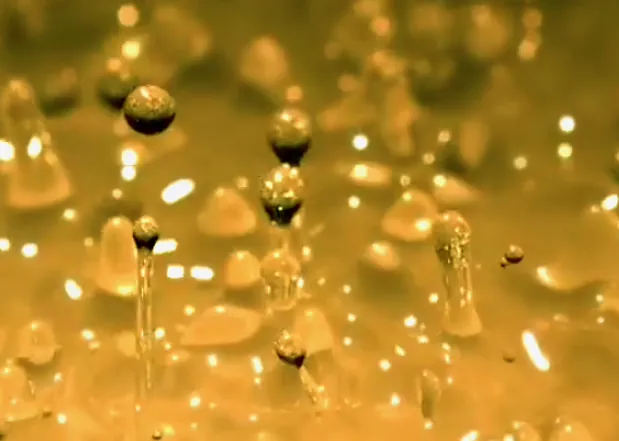
ACCESSORY
Liquid Delivery
An ultrasonic spray nozzle is only as precise as the liquid feed behind it. Because MicroSpray ultrasonic nozzles operate at low flow rates and near-zero pressure, the pump matters more than it does for a pressure nozzle: any pulsation or drift in the feed shows up directly in the film. Syringe pumps are the usual answer, but they are not the only one. Below are the pump types we configure, in rough order of accuracy, with the trade-offs of each. We supply the pump, the delivery line and the syringes or tubing matched to your nozzle, and help you build the delivery setup end to end.
Pump Options
Syringe, peristaltic, gear, piston
Flow Rate Range
Sub-µL/hr to >100 mL/min (pump and syringe dependent)
Best Accuracy
Syringe pumps, typically ±0.35–1% of set rate
Fluid Path
Glass, PTFE, ceramic or disposable tubing to suit the chemistry
Control
Front-panel programs; RS-232 / USB for automation
Nozzle Feeds
Single nozzle or multi-channel
Low Flow Pump Options for Ultrasonic Nozzles
Four ways to feed a nozzle, from the most accurate to the simplest, and what each one costs you.
Syringe Pumps — Multi-Channel, Push-Pull Auto-Refill, Programmable
When you need better accuracy than a peristaltic pump can give you. Paired syringes alternate — one dispenses while the other refills — so you get uninterrupted delivery with precise, repeatable volumes. Flow rate is continuously variable, which makes syringe pumps the natural choice for testing and process development.
Ask about syringe pump configurations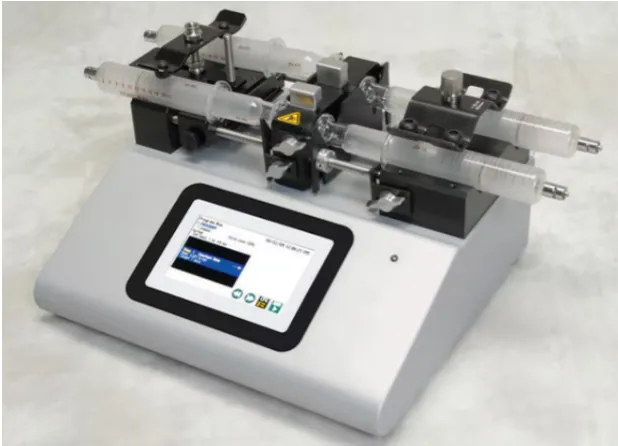
Peristaltic Pumps — Multi-Channel
You'll see a small amount of pulsation from the roller action. Whether that matters is application-dependent — on a continuous coating pass it can show up as slight density variation; for plenty of other uses it's invisible. Fluid only contacts the tubing, which simplifies chemical compatibility.
Ask whether peristaltic suits your coating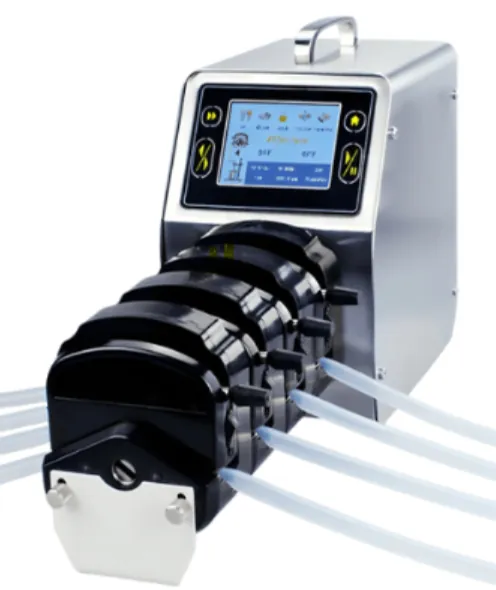
Gear Pumps
These meter very accurately, but watch viscosity. With thin, low-viscosity liquids you can get slippage past the gear clearances, and delivered volume falls off from what you commanded.
Ask about gear pump metering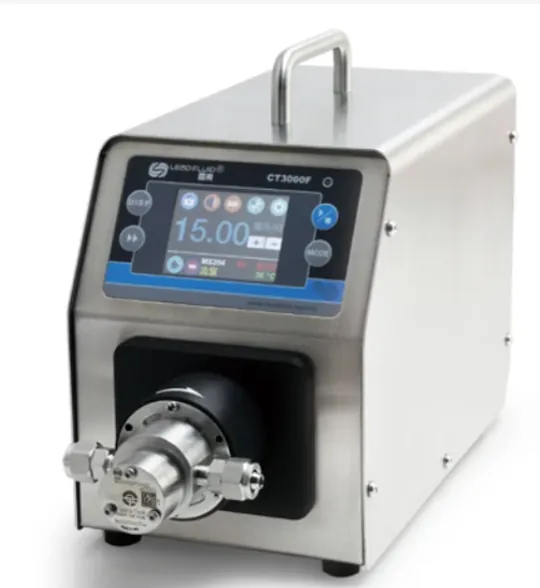
Piston Pumps
Worth considering because they may do both jobs: a specific dose on demand, or continuous run from the same pump. Ceramic piston designs in particular are chemically inert and hold calibration over a very long service life.
Ask about piston pump dosing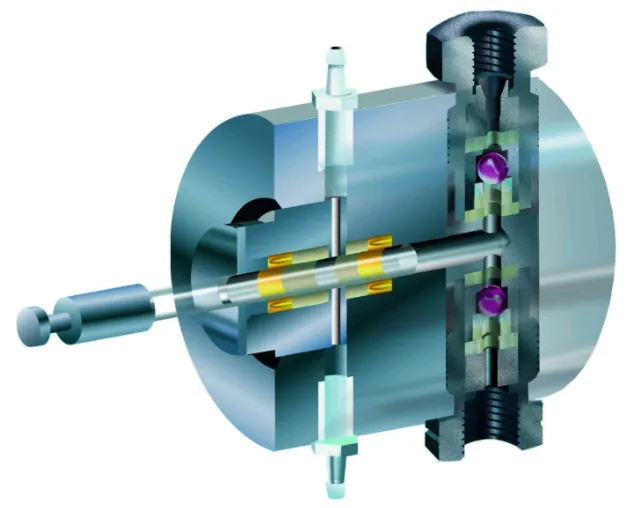
Bottom Line
The right pump configuration falls out of how you plan to lay out the liquid delivery system for your particular application. Give us a few details and we can narrow this to specific recommendations:
- Target flow rate for dosing vs. continuous run, or dose volume and cycle rate
- How tight the flow accuracy needs to be
- Whether you want to dose and run continuous from the same system
- Single nozzle or multiple nozzles to feed
Key Advantages
- Pump matched to the nozzle's low-flow, near-zero-pressure operating point
- Complete fluid path: pump, line, fittings, and syringes or tubing sized for your chemistry
- Dose on demand or continuous run, single nozzle or multi-channel
- Accurate total-volume dispensing for expensive materials — no waste, no overrun