RESEARCH APPLICATION
Ultrasonic Spray Coating for Self-Driving Laboratories
A self-driving laboratory runs an experiment, measures the result, and decides what to try next without a person in the loop. It is the fastest way anyone has found to search a large materials design space, and it works in microliter volumes on small coupons. The question that follows every campaign is whether the recipes it finds survive the trip to a real coating process.
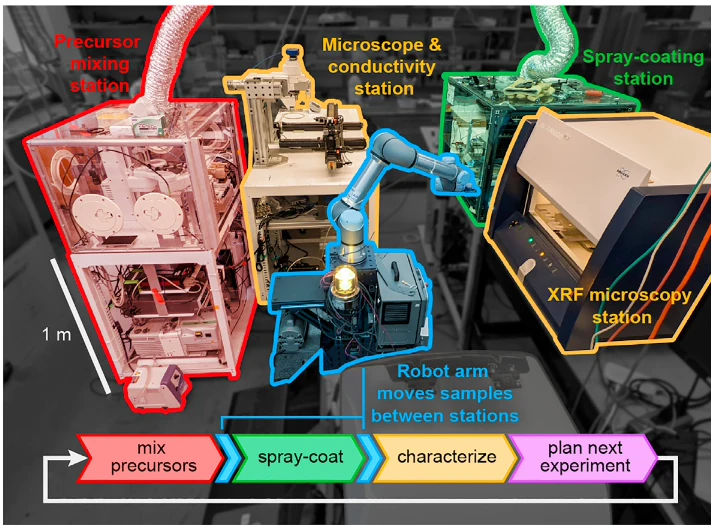
In a 2022 Nature Communications study, a group at the University of British Columbia answered that question with an ultrasonic spray coater. Their self-driving laboratory, Ada, mapped the trade-off between processing temperature and electrical conductivity for palladium films made by combustion synthesis. The recipes it discovered were then spray-coated onto heated glass, and the authors report that the coater was built from a Microspray ultrasonic nozzle operated at 120 kHz.
From a robot's drop-cast sample to a coated part
Ada explores recipes by drop-casting a few microliters of precursor onto a slide, annealing it, and measuring conductance and film thickness by four-point probe and X-ray fluorescence. That is ideal for searching. In the authors' simulations, the multi-objective Bayesian algorithm they used (qEHVI) reached a better Pareto front in under 100 samples than random search managed in 10,000. It is not a manufacturing process: drop-cast films were rough and inhomogeneous, and combustion synthesis had never been shown to make uniform, high-quality metal films over an area larger than a droplet.
The temperature axis mattered as much as the conductivity axis. The prior art for palladium combustion synthesis processed at 250 °C, above what Nafion, polyethersulfone and heat-stabilized PEN tolerate. Ada found acetylacetone-rich fuel blends that produced metallic films below 200 °C, opening those commodity polymers as substrates. Turning that discovery into a coating needed a deposition method that could lay a precursor ink down uniformly over a slide-sized area on a hot plate, with low enough liquid loading that the film formed as the droplets landed instead of pooling.
Where the ultrasonic nozzle fits
The authors built a spray coater from an ultrasonic nozzle (Microspray, USA) mounted on a motorized XYZ gantry above a laboratory hot plate, with precursor fed by a syringe pump. The nozzle ran at 3 W and 120 kHz. For each recipe, 700 µL of ink was sprayed at 2 µL/s from 15 mm above the substrate in a serpentine raster of twelve 50 mm lines, repeated three times, then left to anneal on the hot plate for five minutes. The precursors decomposed in under five minutes into reflective, conductive palladium.
The result validated the autonomous campaign. Three Pareto-front recipes at 191, 200 and 226 °C all gave films roughly 50 to 60 nm thick, with thickness varying by less than 5% of the mean and conductivity by less than 18% across a 26-point map of an 8 × 20 mm region. Conductivity rose more than an order of magnitude over that 35 °C span: 1.1 × 10⁵ S/m at 191 °C and 2.0 × 10⁶ S/m at 226 °C, which the authors compare with 2.0 to 5.8 × 10⁶ S/m for sputtered palladium. Metal films at sputtered-metal conductivity, without vacuum, on large-area substrates.
Why an ultrasonic nozzle was the right tool comes down to the same properties that make it useful in any spray pyrolysis process. Droplet size is set by frequency, not flow rate, so the robot can change liquid delivery without changing the droplet. The mist arrives at low velocity and settles onto the hot substrate instead of splashing, and the titanium liquid path does not clog on precursor inks. And the microliter-per-second flow rates that suit an autonomous campaign are normal operating territory for the nozzle rather than a special case.
Why a Pareto front instead of a single best recipe
Most optimization campaigns pick one objective and maximize it. Real coatings have several that conflict: a palladium film that is more conductive usually needs a higher processing temperature, and a higher temperature rules out the plastic substrates a product may depend on. Choosing a single target in advance forces the researcher to guess where the trade-off should sit before the data exists.
A Pareto front removes the guess. It is the set of recipes for which no objective can be improved without worsening another, so it shows the best achievable conductivity at every processing temperature at once. Ada's campaign mapped that front for palladium combustion synthesis, and the spray-coating experiments then sampled three points along it. A group that needs Nafion-compatible temperatures reads off one recipe; a group that can tolerate 226 °C reads off another, from the same data set.
For spray-coating process development the framing is a natural fit, because the variables the nozzle decouples, droplet size and liquid flow, are exactly the kind of independent axes a multi-objective optimizer wants to move separately.
References for this section
- A self-driving laboratory advances the Pareto front for material properties — MacLeod, Parlane, Rupnow et al., Nature Communications 13, 995 () Open access · no paywall
Why ultrasonic spray suits autonomous materials research
- ✓No lower flow limit, so a screening campaign spends microliters of precursor per sample
- ✓Droplet size set by frequency, independent of flow rate and pressure, giving the optimizer clean, uncoupled process variables
- ✓Low-velocity mist that settles onto heated substrates without splashing, for uniform combustion-synthesis and pyrolysis films
- ✓Titanium liquid path and self-cleaning tip that carry precursor inks, metal salts and suspensions without clogging
- ✓Standalone nozzle and generator that mount on any robot gantry or XYZ stage and take feed from any syringe pump
- ✓The same nozzle carries a recipe from discovery to scale-up, so results transfer without changing the atomization
Peer-reviewed research using a MicroSpray nozzle
Independent research carried out by the authors on their own apparatus, cited as published. The first paper's methods section names the nozzle supplier; both are cited as evidence of what the technique achieved, not as endorsements.
- A self-driving laboratory optimizes a scalable process for making functional coatings
C. C. Rupnow, B. P. MacLeod, et al. — Berlinguette Group, University of British Columbia
Cell Reports Physical Science ·
Open access · no paywall
Spray deposition in this work was performed using a MicroSpray ultrasonic spray system.
- A self-driving laboratory advances the Pareto front for material properties
B. P. MacLeod, F. G. L. Parlane, C. C. Rupnow, K. E. Dettelbach, M. S. Elliott, T. D. Morrissey, T. H. Haley, O. Proskurin, M. B. Rooney, N. Taherimakhsousi, D. J. Dvorak, H. N. Chiu, C. E. B. Waizenegger, K. Ocean, M. Mokhtari & C. P. Berlinguette — University of British Columbia
Nature Communications 13, 995 ·
Open access · no paywall
Methods: "The spray coater was built from an ultrasonic nozzle (Microspray, USA) ... The ultrasonic spray nozzle was operated at 3 W and 120 kHz."
Recommended Equipment
Focused Nozzle
Available at 120 kHz, the frequency used in the published work; a tight pattern suits serpentine raster coating of small coupons
View details →ThermalSpray™ High-Temperature Ultrasonic Nozzle
For long runs close to a hot plate or heated substrate, where a standard nozzle body would heat-soak
View details →Liquid Delivery (Dosing Pump)
Pulse-free syringe-pump feed at the microliter-per-second rates autonomous campaigns run at
View details →Common Questions from Research Groups
Can an ultrasonic nozzle be integrated into a self-driving laboratory?
Yes. The nozzle and its generator are standalone components with no proprietary motion or fluid system, so they mount on whatever the lab already automates. In the published work the coater was an ultrasonic nozzle on a commercial motorized XYZ gantry above a laboratory hot plate, fed by a laboratory syringe pump. Motion, fluid delivery and heating all came from the group's own hardware.
How much precursor does a spray-coated sample take?
In the published work, 700 µL of precursor ink coated a 75 × 25 mm microscope slide at a spray flow rate of 2 µL/s. Ultrasonic atomization has no lower flow limit, so smaller coupons or thinner films simply use less.
Do recipes found by drop casting translate to spray coating?
That was the central test of the paper, and the answer was yes: three recipes taken from the autonomously discovered Pareto front produced uniform 50 to 60 nm films by spray, with conductivity rising with temperature as the campaign predicted. The authors verified this with additional spray experiments rather than assuming it, which is the approach we recommend: use the robot to find the region, then confirm the transfer with a handful of sprayed samples.
Why 120 kHz?
Higher frequency gives smaller droplets. Our 120 kHz nozzles produce roughly 12 to 15 µm median droplets measured near the tip, which suits thin films from dilute precursor because each droplet carries little liquid and dries or reacts quickly on a heated substrate. The trade-off is a lower maximum flow rate, which is no constraint at microliter-per-second delivery.
Can this approach coat plastics?
Driving the processing temperature down was the paper's motivation. The prior art for palladium combustion synthesis ran at 250 °C; the recipes Ada found produced metallic films below 200 °C, which the authors note brings polymers such as Nafion, polyethersulfone and heat-stabilized PEN into range as substrates. Whether a given polymer tolerates a given recipe is a question for your own trials.
Building or upgrading a self-driving laboratory?
MicroSpray in Spring Mills, Pennsylvania supplies the ultrasonic nozzle and generator as standalone components you integrate into your own robot, stage and fluidics. Tell us your precursor chemistry, substrate, hot-plate temperature and target thickness and we will match a nozzle configuration to it.