How Ultrasonic Spray Nozzles Work
Ultrasonic atomizing nozzles convert high-frequency electrical signals into acoustic waves transmitted through a waveguide (horn) that couples those waves into a low-viscosity liquid film on the nozzle surface.
The resonant frequency is set by the geometry of the titanium waveguide, which establishes a standing wave with a displacement antinode at the tip. That standing wave drives precision-controlled micro-droplets at a size determined entirely by the chosen frequency — enabling zero-air atomization with virtually no lower flow rate limit and unparalleled thin-film coating control.
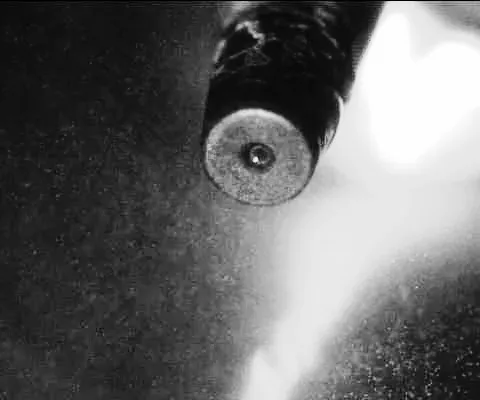
High-Speed Zero-Air Atomization
- Camera speed
- approximately 100,000 frames per second
- Nozzle
- Zero-Air Nozzle, 60 kHz
Footage courtesy of the US DOE National Energy Technology Laboratory (NETL)
Capillary Wave Instability
The nozzle tip vibrates tens of thousands of times a second. Liquid fed onto it at a few psi spreads into a thin film, and the vibration writes standing capillary waves into that film. Past a threshold amplitude the wave crests sharpen, go unstable, and break off as droplets. This is the dominant mechanism at the gentle power levels coating work uses.
Acoustic Cavitation
A second mechanism runs alongside it. Pressure swings inside the film nucleate microscopic vapor cavities on the rarefaction half-cycle and collapse them on the compression half-cycle, and the resulting micro-shockwaves help break up the surrounding liquid. Cavitation's share grows with drive power, which is why excess amplitude coarsens a spray rather than refining it.
Why They Don't Do Viscous
Viscous damping of the capillary wave. The film has to sustain a standing surface wave. Damping rate goes roughly as νk², and from the capillary dispersion relation k scales as ω^(2/3) — so damping climbs as roughly ν·f^(4/3). Viscosity doesn't just resist a little; the threshold amplitude for wave onset rises steeply, and at some point you can't reach it before other things break.
The film won't thin out. A viscous liquid doesn't spread across the atomizing surface, it sits as a lens. Only a layer near the surface actually participates in the motion — the viscous penetration depth, δ = √(2ν/ω). Liquid above that is dead mass being dragged along, absorbing power and returning nothing.
Ligament breakup resists. Even if crests form, the Ohnesorge number Oh = μ/√(ρσD) rises, and viscous forces hold the ejected ligament together instead of letting it pinch into a droplet. You get strings, not drops.
The load damps the transducer. A viscous film is a lossy acoustic load. It pulls down Q, shifts resonance and drops tip amplitude — exactly when you need more amplitude.
Precision Droplet Control with Ultrasonic Atomization
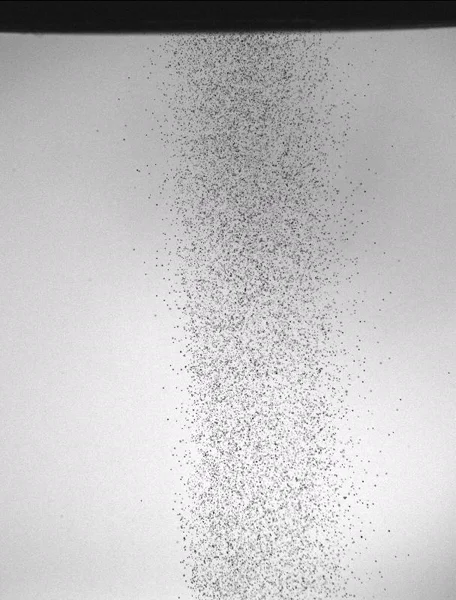
High-Speed Atomization of Potassium Carbonate Solution
Ultrasonic nozzle atomizing a potassium carbonate (K₂CO₃) solution at 1 mL/min and 7 W, captured at 1,000 frames per second with a 1 µs exposure; frames 100–200 of the sequence, played back at 10 frames per second. Compliments of the US DOE National Energy Technology Laboratory (NETL).
Droplet Size Is Not the Whole Story
Nozzle frequency sets the droplet size as the droplets leave the nozzle. It does not describe what arrives at your substrate — and across the peer-reviewed literature, that distinction is the difference between a process that works and one that does not.
Film quality is governed by a wetness and evaporation balance. Droplets have to reach the surface wet enough to spread and merge into a continuous layer, but not so wet that flooding, dewetting, or coffee-ring flow takes over. Published work on polymer electronics, perovskites, pyrolytic oxides, and smoothing coatings converges on the same conclusion: nozzle height, carrier gas, substrate temperature, solvent volatility, flow rate, and traverse speed all act through this single balance.
Between the nozzle and the substrate, droplets evaporate. They arrive smaller than they left, and with a higher solids fraction — and with a mixed solvent, the composition itself shifts in flight because the more volatile component leaves first. The practical consequence is that droplet size at the nozzle and wetness at impact are two separate process variables, and treating the nozzle's rated diameter as the only quantity that matters is the most common modelling error in this field.
This is also why ultrasonic atomization is useful for process development rather than just for making fine droplets: because frequency sets the initial distribution independently of flow rate, you can change how much liquid you deliver without changing droplet size, and change droplet size without re-plumbing the system. That separation is what makes the balance above tunable instead of accidental.
What you actually tune
- Ultrasonic frequency — sets the initial droplet distribution
- Liquid flow rate — sets delivered volume, independently of droplet size
- Nozzle-to-substrate standoff — sets flight time, and therefore evaporation
- Shaping/carrier gas rate — sets pattern width and approach velocity
- Substrate or gas temperature — sets drying rate at and after impact
- Traverse speed and number of passes — decouple total loading from single-pass wetness
References for this section
- Process Optimization of Ultrasonic Spray Coating of Polymer Films — Bose et al., Langmuir ()
- Modeling thin film formation by Ultrasonic Spray method: A case of PEDOT:PSS thin films — Lonakar et al., Organic Electronics ()
- Design and experiment of low-frequency ultrasonic nozzle integrating air-assistant system and acoustic levitation mechanism — Gao et al., International Journal of Agricultural and Biological Engineering () Open access · no paywall
- Ultrasonic Atomization of Liquids — R. J. Lang, Journal of the Acoustical Society of America ()
Engineered for Performance
Fabricated from high-strength titanium alloy with sealed electrically active elements, ensuring complete chemical resistance. The liquid path contacts only titanium, preventing contamination or degradation.
The non-clogging design is ideal for nanoscale materials prone to flocculation. Low-velocity mist can be shaped using air-shaping devices into fine lines, conical patterns, or wide flat fans for precise deposition control.
- Film thickness control within ±2%
- Transfer efficiency exceeding 95%
- Clog-resistant design minimizes downtime
- Scalable from R&D to high-volume production
Applications
Ultrasonic spray nozzles are used across industries requiring high-performance coating and precise material deposition:
- Medical device coating
- Solar cell and fuel cell fabrication
- Spray pyrolysis
- Pharmaceutical layering
- Semiconductor thin films
- Conductive ink deposition
Their use ensures uniformity, minimizes overspray, and maximizes transfer efficiency — leading to superior film quality, reduced material waste, and enhanced product performance.
Ultrasonic Spray Shaping
Ultrasonic atomization produces a soft, low-velocity mist — and because the droplets carry almost no momentum of their own, the spray pattern can be shaped aerodynamically after atomization. Ultrasonic spray shaping uses precisely directed air streams to form that mist into the exact pattern a process needs: a pinpoint focal spot, a wide stabilized cone, or a flat fan sheet.
This separation of atomization from pattern control is what makes ultrasonic spray shaping so flexible: droplet size is set by the nozzle frequency, while the shaping air independently sets pattern width, throw distance, and impact energy. Each MicroSpray shaping configuration is built around the same core ultrasonic nozzle, so a process developed with one pattern can move to another without changing the coating chemistry.
Focused point
Focused Nozzle
A coaxial air sheath compresses the plume to a ~1/8 inch (3.2 mm) focal point for microscale targets.
Wide cone
Vortex Nozzle
A spiral gas stream spins the mist into a stable, wide-angle cone for large-area uniformity.
Flat fan
SprayBlade™ Air Knife
A laminar flat air jet spreads the mist into a 6–12 inch sheet for wide substrates and roll-to-roll lines.
Narrow stream
MicroStream™ Nozzle
A dual-fluid cannula confines the spray to an ultra-narrow 0.007 inch stream for fine features.
Peer-Reviewed Studies
Drawn from our survey of 59 peer-reviewed studies (2001–2026) that used an ultrasonic spray nozzle. Read the survey →
Three research families dominate: formation of continuous functional films, formation of discrete particles or powders by droplet-to-particle conversion, and controlled deposition of particle suspensions and catalyst inks.
The same physical variables recur in all three: frequency, liquid viscosity and surface tension, flow rate, carrier-gas rate, nozzle-to-target distance, substrate or gas temperature, traverse speed, and number of passes.
For continuous films the central question is whether adjacent droplets can merge before solidification. For powders it is how each droplet dries or reacts. For porous electrodes the target is deliberately intermediate: enough drying to prevent flooding, while retaining interconnected porosity.
A frequent misconception is treating the initial nozzle droplet diameter as the only controlling quantity. These papers repeatedly show that evaporation during flight and after impact can dominate morphology. Droplet size at the nozzle and wetness or solids fraction at impact should be treated as two separate process variables.
Two rationales also recur regardless of cluster. High-value materials drive adoption: platinum catalysts, pharmaceutical actives, perovskite precursors and nanocarbons appear again and again because transfer efficiency and accurate loading matter most where the coating itself is expensive. Scalability is the other: organic electronics, solar cells, flow batteries and textiles position ultrasonic spray as compatible with automated XY raster and roll-to-roll coating.
Reported frequencies and droplet sizes
Where an operating frequency was reported, the distribution across the surveyed papers is: 120 kHz (7), 48 kHz (3), 20 kHz (1), 60 kHz (1), 80 kHz (1), 100 kHz (1), 250 kHz (1).
Relatively few papers report both an operating frequency and a measured aerosol diameter. The strongest examples are a 60 kHz air-assisted nozzle study reporting mean diameters spanning roughly 11.5 to 52 µm across operating conditions, and a 120 kHz zirconia spray-pyrolysis study reporting a precursor-droplet peak near 28 µm. One lithium-ion anode paper using a 48 kHz nozzle cites a 38 µm mean droplet rating for water, but that value was not measured for the actual silicon suspension.
Frequency is therefore best treated as one atomization variable rather than a stand-alone predictor of deposited-film morphology. Liquid properties, air shaping, nozzle geometry, flight distance, solvent evaporation, substrate temperature and solids loading can all change droplet state before impact.
Note also that dried powder size, nanoparticle size, matrix-crystal size and deposited-film thickness are not aerosol droplet sizes, and are not recorded as such in the survey's tables — a conflation that appears often in secondary sources.
Supporting peer-reviewed reviews
These are useful for validating themes, but are not direct experimental evidence.
References for this section
- Thin film deposition using spray pyrolysis — D. Perednis & L. J. Gauckler, Journal of Electroceramics 14, 103–111 () Free copy (author version) →
- Novel approaches based on ultrasound for spray drying of food and bioactive compounds — K. Khaire & P. R. Gogate, Drying Technology ()
- Factors influencing droplet size in pneumatic and ultrasonic atomization for food emulsions — Camacho-Lie et al., Discover Food () Open access · no paywall
- The Development of Spray-Coated Perovskite Solar Cells — J. E. Bishop, J. A. Smith & D. G. Lidzey, ACS Applied Materials & Interfaces () Open access · no paywall
Frequently asked questions
Peer Review Lit
Technical articles, how-to guides, and peer-reviewed literature
Basics of Ultrasonic Atomization
Foundational overview of how ultrasonic atomization works and its applications in thin-film coating.
Read article →Understanding Energy in Motion
Fundamentals of longitudinal and transverse wave motion, acoustic phenomena, and energy propagation through media.
Read article →Automated Coating Optimization with MicroSpray Nozzles
Self-driving laboratory uses Bayesian optimization to autonomously scale up high-performance palladium film deposition via ultrasonic spray combustion.
Read article →13 technical articles on ultrasonic atomization and thin-film coating
Featured Videos
See ultrasonic spray nozzles and coating systems in action
How Ultrasonic Spray Nozzles Work
Overview of MicroSpray ultrasonic atomization technology and nozzle operation
Blood Collection Tube Coating
Ultrasonic nozzle coating process for BCT manufacturing