ENERGY APPLICATION
Electrocatalysis Coating
Precision catalyst layer deposition for electrochemical cells including alkaline water electrolyzers, PEM electrolyzers, solid oxide electrolyzers, and CO2 reduction systems for green hydrogen production. Our nozzles have also been used to dispense MXene inks for electrocatalyst supports and conductive electrode layers, alongside metal and oxide nanoparticle inks.
The Challenge
Modern electrolyzer electrodes require highly uniform, thin-film catalyst coatings for efficient hydrogen production and carbon dioxide electroreduction. Traditional methods waste expensive catalysts like iridium oxide and platinum, produce inconsistent electrode layers, and struggle with the nanoparticle suspensions used in advanced electrocatalyst formulations.
MXenes are one of several two-dimensional materials now being studied as thin functional and protective layers in nanofabrication, where a scalable way to coat or grow them matters as much as the material. New hard-mask materials for deep etching reach the wafer in two ways: some are applied as a liquid, while layered crystalline masks are not made from a liquid at all and must be grown from vapor.
Our Solution
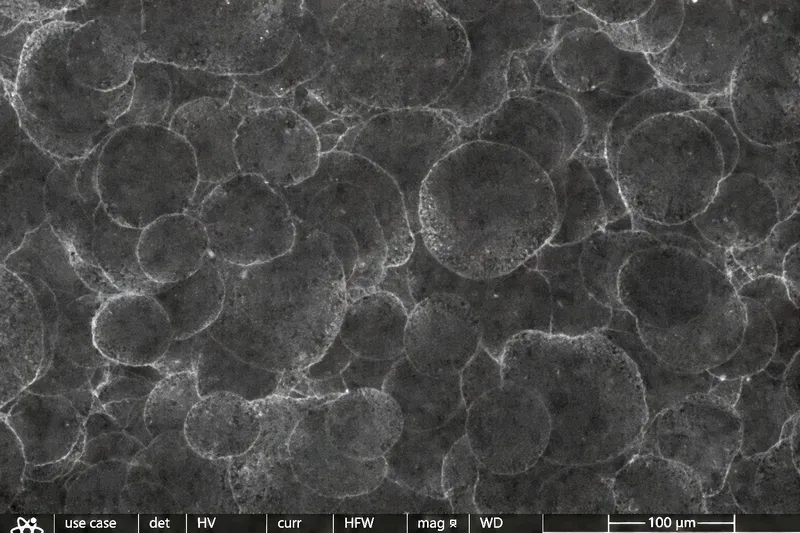
MicroSpray ultrasonic nozzles produce micron-scale droplets with low momentum and precise spatial control, improving catalyst utilization and reducing material waste across alkaline, PEM, solid oxide, and CO2 electrolyzer platforms. The airless, low-velocity atomization eliminates blowback and overspray when coating fine-patterned catalyst-coated membranes. Our nozzles have also been used to dispense MXene suspensions, the two-dimensional transition-metal carbides and nitrides used as electrocatalyst supports and conductive electrode layers; the image above shows MXene deposited with the 120 kHz Vortex Nozzle.
Ultrasonic spray builds the film in thin passes with direct control over thickness, so the same MXene or other 2D-material formulation can be tested on coupons and then on wafers. For films that must be grown from vapor, the nozzle can instead meter a precursor solution into a CVD or MOCVD reactor. The MXene white paper covers the published spray results, and both routes for etch masks, with references, are described on the Photoresist & Polyimide Coating page.
Why Ultrasonic Spray?
- ✓Uniform nickel-based catalyst layers for alkaline water electrolysis, including Ni-Fe and Ni-Co alloys for enhanced oxygen evolution activity
- ✓Precision iridium oxide placement for PEM electrolyzers enables drastic loading reduction while maintaining high OER current densities
- ✓Homogeneous Ni-YSZ cermet dispersion for solid oxide electrolyzers with controlled porosity gradients and thermal cycling resistance
- ✓Controlled Cu/Ag nanoparticle deposition on gas diffusion electrodes for CO2 reduction with higher Faradaic efficiency
- ✓Micron-scale droplet generation for precise catalyst film thickness and porosity control
- ✓Low-velocity misting prevents catalyst agglomeration and eliminates overspray and blowback
- ✓Non-clogging delivery compatible with nanoparticle suspensions
- ✓Used to dispense MXene dispersions as well as metal and oxide nanoparticle inks
- ✓Scalable from laboratory R&D to industrial electrode manufacturing
- ✓Applicable to chlor-alkali, ammonia, green hydrogen, e-fuel, power-to-liquid, and carbon valorization systems
Scalable Coating and Precursor Delivery for Hard-Mask and 2D Material Films
What we have sprayed
- ✓MXene dispersions, deposited with our 120 kHz Vortex Nozzle
- ✓Photoresist and polyimide over three-dimensional MEMS structures
- ✓Sol-gel and metal oxide precursor solutions
Why teams consider spray for scale-up
- ✓Works on substrates spin coating handles poorly: square or irregular pieces, large panels, and surfaces with existing topography.
- ✓Thickness set pass by pass, so a film is built up in thin layers with direct control over thickness.
- ✓Low material use. The low-velocity spray puts most of the liquid on the substrate, which matters when a precursor is expensive or scarce.
- ✓Scales by motion, not by tooling. The same nozzle covers a coupon or a wafer by changing the scan path.
Precursor delivery for CVD and MOCVD
When a film has to be grown from vapor, the hard part is often getting the precursor into the reactor at a steady rate. Solid powders and low-volatility compounds are difficult to evaporate evenly from a boat or bubbler. Liquid delivery solves this by dissolving the precursor and atomizing the solution into a heated zone, where the fine droplets evaporate quickly. The dose is then set by the liquid flow rate.
- ✓Steady, metered dose set by a pump, not by the temperature of a solid source
- ✓Small droplets that evaporate fast (median 12–15 µm at 120 kHz)
- ✓Continuous or pulsed feed
- ✓Low-velocity spray suited to vaporizer and carrier-gas designs
Ultrasonic nozzles have been used this way in published CVD and MOCVD work. If your team is moving a new film from small samples toward wafer-scale growth, we can help you evaluate liquid delivery for your precursor.
At a glance
| Nozzle frequency | 60 kHz or 120 kHz |
|---|---|
| Median droplet size | 31 µm at 60 kHz; 12–15 µm at 120 kHz |
| Flow rate | No lower limit; set by the pump |
| Liquid viscosity | Below 50 cP, ideally below 20 cP |
| Wetted materials | Titanium, stainless steel, PTFE |
For SBIR and STTR proposal teams
If your proposal needs a scalable coating method or a precursor delivery method for a mask or 2D material film, we can support it with:
- ✓An equipment quote for your budget in as little as 48 hours (business days only)
Questions we expect you to ask
- How smooth and uniform is a sprayed film at nanometer thickness?
- It depends on the formulation, solvent, and substrate, so it is best measured on samples sprayed with your own material. Contact us to discuss testing your film.
- Can an ultrasonic nozzle feed a CVD or MOCVD reactor?
- Yes. The nozzle atomizes a precursor solution into a heated vaporizer or a carrier gas stream, so the precursor arrives as vapor and the film grows from the gas phase. Whether this works for your chemistry depends on finding a solvent and precursor that evaporate cleanly; we can help you test that.
- What about metal and particle contamination?
- Wetted parts are titanium, stainless steel, and PTFE, so a sprayed film can be checked against your own contamination standard.
- Do we have to buy a complete coating system?
- No. The nozzle and generator are standalone components that mount on your own motion stage, vaporizer, or reactor port, in your own cleanroom or glovebox.
Supporting Research
Peer-reviewed publications and technical literature relevant to this application area. Links open the publisher's site.
- Ordered CoPt oxygen reduction catalyst with high performance and durability
Pan et al.
Chem Catalysis ·
Open access · no paywall
- Numerical Investigations on the Ultrasonic Atomization of Catalyst Inks for Proton Exchange Membrane Fuel Cells
Li et al.
Journal of The Electrochemical Society ·
- Testing fuel cell catalysts under more realistic reaction conditions: accelerated stress tests in a gas diffusion electrode setup
Alinejad et al.
Journal of Physics: Energy ·
Open access · no paywall
Recommended Equipment
Vortex Nozzle
Wide, uniform spray pattern for coating electrode substrates and membranes
View details →ThermalSpray™ High-Temperature Ultrasonic Nozzle
Required for high-temperature cermet electrode deposition in SOEC applications
View details →Liquid Delivery (Dosing Pump)
Pulse-free low-flow dosing for accurate, repeatable catalyst loading
View details →Common Questions from Research Groups
Can the nozzle coat catalyst layers from both aqueous and solvent-based suspensions?
Yes. Catalyst inks in water, alcohols, and mixed solvents all atomize well. The ultrasonic tip continuously redisperses the suspension, so nanoparticle catalysts stay uniform in the spray instead of settling or agglomerating — one of the main reasons research groups move from airbrush or pressure spraying to ultrasonic.
What droplet sizes are typical at low flow rates?
Droplet size follows the nozzle frequency rather than the flow rate: about 30–35 µm at 60 kHz and 12–15 µm at 120 kHz. Typical electrode-coating flow rates run from below 0.5 mL/min up to several mL/min, and the droplet spectrum stays consistent across that range.
Do I need a full coating system, or can I buy the nozzle and generator alone?
Standalone components are how most research groups buy: a nozzle, its generator/controller, and optionally a syringe pump for pulse-free feed. Mount it in your own coating rig or glovebox using our standard adapters. There is no requirement to purchase a complete coating system.
How much catalyst does ultrasonic spraying actually save?
The low-velocity, airless spray means very little material bounces off or drifts past the substrate, so transfer efficiency is high compared to pressure spraying — the reason groups working with iridium, platinum, and other precious-metal catalysts adopt it. The exact figure depends on your substrate size and standoff; we're happy to discuss your geometry.
Do you support university groups in Europe?
Yes. MicroSpray products are made in the USA and shipped worldwide, and we work with academic and R&D groups regularly. Technical support comes directly from our engineers by email and video call. Contact us for lead times and shipping to your country.
Optimize your electrocatalyst coating process. Contact us for a technical consultation.
Let's discuss your specific coating requirements.