
ELECTRONICS APPLICATION
Photoresist & Polyimide Coating
Ultrasonic spray coating of photoresists and polyimide dielectrics — conformal coverage over 3D MEMS structures, deep cavities, and non-round substrates where spin coating fails or wastes most of the material.
The Challenge
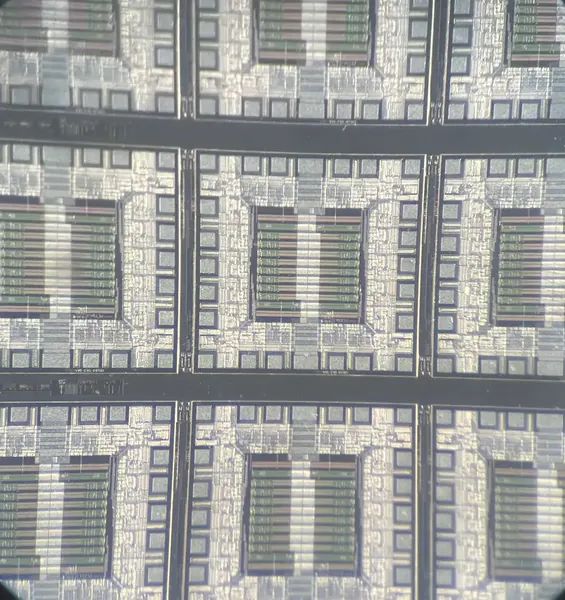
Spin coating is the default for photoresist, but it only works well on flat, round wafers, and less than 5% of the dispensed resist stays on the wafer.1 On MEMS devices with etched cavities, through-silicon vias, wafer bumps, or diced and irregular substrates, spin coating leaves thin spots on edges and corners, pools resist in recesses, and cannot coat sidewalls evenly.2 Polyimide and other dielectric layers face the same limits.
The next generation of etch masks raises a related question. Some hard-mask materials are applied as a liquid, such as spin-on metal oxide hard masks.3 Others, including the layered crystalline masks recently shown to withstand deep silicon etching, are not made from a liquid at all, and will need to be grown from vapor to cover full wafers.4
Our Solution
MicroSpray ultrasonic nozzles deposit photoresist and polyimide (diluted for spraying) as a fine, low-velocity mist that follows the substrate topography instead of fighting it. Droplets land and coalesce over steps, trenches, and cavity sidewalls, building the target thickness in controlled passes. Published work with ultrasonic spray coating reports two to three times more wafers coated per volume of resist than spin coating.2 Because substrate shape no longer matters, squares, strips, and singulated die coat as easily as whole wafers.
For liquid-applied mask materials, the same spray process builds the layer in thin passes with direct control over thickness, so a formulation can be tested on coupons and then on wafers. Masks that must be grown from vapor need a different route, described below.
Vapor-Assisted Deposition for Crystalline Hard Masks
Crystalline hard masks are a poor fit for direct spraying, because droplets landing on the wafer would likely break the film into grains. They need to be grown from vapor. Ultrasonic nozzles already have a published role here as the precursor feed: the nozzle atomizes a precursor solution into a heated vaporizer or carrier gas, and only vapor reaches the wafer.5,6 The dose is set by the liquid flow rate, which is steadier than evaporating a solid powder, the source used in the reported CVD growth of CrOCl so far.7
A further step is a close-proximity (spatial) deposition head. It holds the vapor outlet a fraction of a millimetre above a moving wafer and builds thickness pass by pass, an approach already used in spatial atomic layer deposition.8 A line-shaped head scales to larger wafers by its length.
Neither route has yet been shown for 2D crystalline hard masks. The open question is chemistry: finding a liquid precursor that grows the right crystal. We are looking for research and proposal partners to test it.
We have also sprayed MXene dispersions with our 120 kHz Vortex Nozzle; the MXene white paper covers the published results.
Why Ultrasonic Spray?
- ✓Conformal coverage over MEMS structures, deep cavities, and via sidewalls
- ✓Uniform films on square, rectangular, and irregular substrates — not just round wafers
- ✓Uses 50–70% less photoresist than spin coating2
- ✓Film thickness controlled by feed rate and pass count, from sub-micron to tens of microns
- ✓Handles polyimide and other dielectrics with dilution control
- ✓Gentle, low-velocity spray safe for fragile released MEMS structures
- ✓No edge bead — usable area extends to the substrate edge
- ✓Scales from single-die R&D to automated wafer track integration
Scalable Coating and Precursor Delivery for Hard-Mask and 2D Material Films
What we have sprayed
- ✓Photoresist and polyimide over three-dimensional MEMS structures
- ✓MXene dispersions, deposited with our 120 kHz Vortex Nozzle
- ✓Sol-gel and metal oxide precursor solutions
Why teams consider spray for scale-up
- ✓Works on substrates spin coating handles poorly: square or irregular pieces, large panels, and surfaces with existing topography.
- ✓Thickness set pass by pass, so a film is built up in thin layers with direct control over thickness.
- ✓Low material use. The low-velocity spray puts most of the liquid on the substrate, which matters when a precursor is expensive or scarce.
- ✓Scales by motion, not by tooling. The same nozzle covers a coupon or a wafer by changing the scan path.
Precursor delivery for CVD and MOCVD
When a film has to be grown from vapor, the hard part is often getting the precursor into the reactor at a steady rate. Solid powders and low-volatility compounds are difficult to evaporate evenly from a boat or bubbler. Liquid delivery solves this by dissolving the precursor and atomizing the solution into a heated zone, where the fine droplets evaporate quickly. The dose is then set by the liquid flow rate.
- ✓Steady, metered dose set by a pump, not by the temperature of a solid source
- ✓Small droplets that evaporate fast (median 12–15 µm at 120 kHz)
- ✓Continuous or pulsed feed
- ✓Low-velocity spray suited to vaporizer and carrier-gas designs
Ultrasonic nozzles have been used this way in published CVD and MOCVD work. If your team is moving a new film from small samples toward wafer-scale growth, we can help you evaluate liquid delivery for your precursor.
At a glance
| Nozzle frequency | 60 kHz or 120 kHz |
|---|---|
| Median droplet size | 31 µm at 60 kHz; 12–15 µm at 120 kHz |
| Flow rate | No lower limit; set by the pump |
| Liquid viscosity | Below 50 cP, ideally below 20 cP |
| Wetted materials | Titanium, stainless steel, PTFE |
For SBIR and STTR proposal teams
If your proposal needs a scalable coating method or a precursor delivery method for a mask or 2D material film, we can support it with:
- ✓An equipment quote for your budget in as little as 48 hours (business days only)
Questions we expect you to ask
- How smooth and uniform is a sprayed film at nanometer thickness?
- It depends on the formulation, solvent, and substrate, so it is best measured on samples sprayed with your own material. Contact us to discuss testing your film.
- Can an ultrasonic nozzle feed a CVD or MOCVD reactor?
- Yes. The nozzle atomizes a precursor solution into a heated vaporizer or a carrier gas stream, so the precursor arrives as vapor and the film grows from the gas phase. Whether this works for your chemistry depends on finding a solvent and precursor that evaporate cleanly; we can help you test that.
- What about metal and particle contamination?
- Wetted parts are titanium, stainless steel, and PTFE, so a sprayed film can be checked against your own contamination standard.
- Do we have to buy a complete coating system?
- No. The nozzle and generator are standalone components that mount on your own motion stage, vaporizer, or reactor port, in your own cleanroom or glovebox.
References
- US Patent 9,720,325, Photoresist coating scheme, TSMC (2017)
- Pham N.P., Burghartz J.N., Sarro P.M., Spray coating of photoresist for pattern transfer on high topography surfaces, J. Micromech. Microeng. 15, 691–697 (2005)
- Mannaert G., Altamirano-Sánchez E. et al., Spin-on metal oxide materials for N7 and beyond patterning applications, Proc. SPIE 10149, 101490T (2017)
- Venkatram P. et al. (Penn State), Two-dimensional crystalline hard masks for high-aspect-ratio nanofabrication, Nature Materials 25, 737–746 (2026)
- US Patent 5,451,260, Method and apparatus for CVD using liquid delivery system with an ultrasonic nozzle (1995)
- Krumdieck S.P., Raj R., Experimental characterization and modeling of pulsed MOCVD with ultrasonic atomization of liquid precursor, Chemical Vapor Deposition 7, 85–90 (2001)
- Chen C. et al., Chemical vapor deposition growth of continuous monolayer antiferromagnetic CrOCl films, arXiv:2511.14189 (preprint)
- Chen M., Nijboer M.P., Kovalgin A.Y. et al., Atmospheric-pressure atomic layer deposition: recent applications and new emerging applications in high-porosity/3D materials, Dalton Trans. 52, 10254–10277 (2023)
Supporting Research
Peer-reviewed publications and technical literature relevant to this application area. Links open the publisher's site.
- Development and Implementation of a Rotating Nanoimprint Lithography Process for Non-Planar Optics
Supreeti et al.
International Journal of Precision Engineering and Manufacturing-Green Technology ·
Open access · no paywall
- Surface Roughness Reduction of Additive Manufactured Products by Applying a Functional Coating Using Ultrasonic Spray Coating
Slegers et al.
Coatings ·
Open access · no paywall
Recommended Equipment
MicroStream™ Nozzle
Ultra-narrow stream for selective resist application on singulated die
View details →Coating resist on non-flat or non-round substrates? Talk to us about spray coating.
Let's discuss your specific coating requirements.